
Imagine a winter morning. 65-year-old Aunt Zhang is gently doing morning exercises in the living room of her home. Outside, the cold air is biting, but inside, the LS-J-01B household oxygen generator, which is running silently, fills the room with vitality. She touches the night light button on the side of the device, and a soft blue light comes on. The earplug-style oxygen inhalation tube delivers delicate oxygen to her nose. This machine, weighing only 5.2 kilograms, is running at a low noise level of 48 decibels – equivalent to the sound of a library page turning – seamlessly blending into the tranquility of the morning. Aunt Zhang’s husband, Old Li, is using the nasal inhalation interface to inhale oxygen simultaneously. They share the same device but do not interfere with each other. This is the epitome of how digital technology reshapes family health management: precise, quiet, and non-intrusive.
I. Core Performance Analysis: How Technology Reconstructs the Breathing Experience
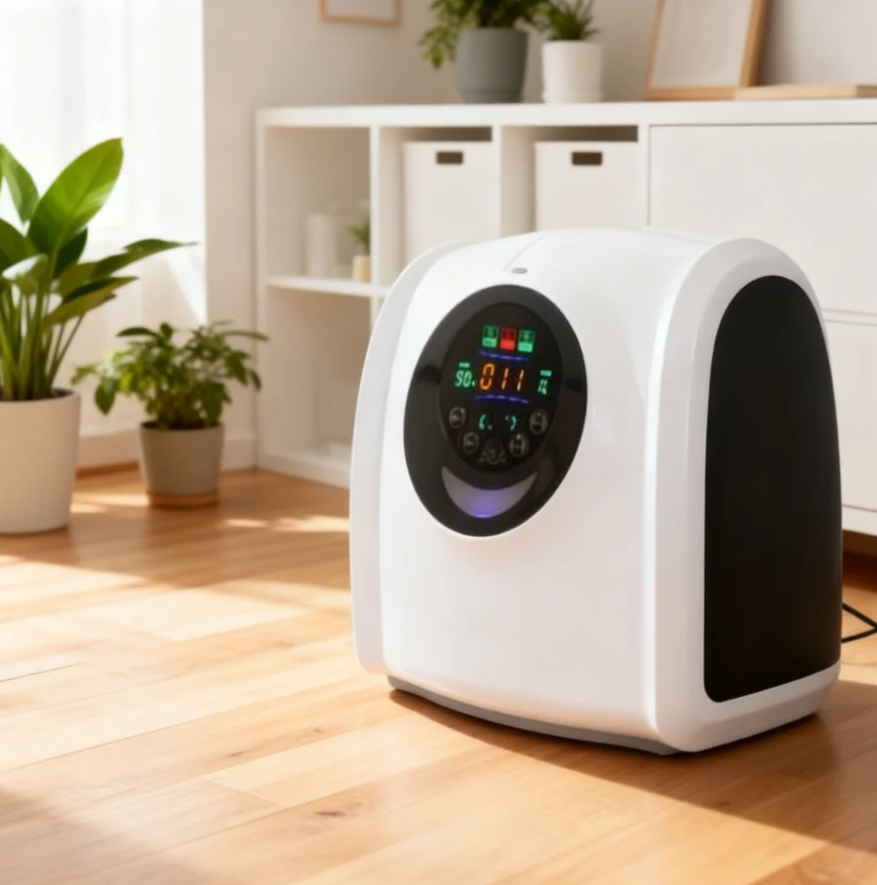
1.Generation Technology and Medical Standards
- Pressure Swing Adsorption (PSA) Technology: This technology dynamically separates oxygen through molecular sieves, ensuring a 90% high-concentration output that meets medical standards.
- Dual-person Synchronized Oxygen Supply: With a maximum flow rate of 6L/min, it supports two people to use simultaneously, meeting the needs of multiple family members.
- Intelligent Concentration Adjustment: Three levels of electric adjustment (1L/min – 90%, 3L/min – 40%, 6L/min – 30%), suitable for different health conditions.
2.Silence mode and user-friendly design
- 48 decibel low noise: Utilizing imported French molecular sieve and ceramic valve systems, the operating noise is lower than the ambient background noise.
- Night light interaction: The touchable night light button prevents light from being turned on during the night, creating an immersive experience.
- Portable and flexible: With a size of 325×302×168mm and a weight of 5.2kg, it can be easily moved to the bedroom, living room, or vehicle environment.
3.Health Enhancement Function
- Negative ion purification: Output of ≥ 6 million negative ions per cubic centimeter, neutralizing indoor dust and odors.
- Atomization integration: Built-in atomization function, allowing direct connection of accessories for respiratory care.
- Safety protection: Intelligent temperature control and overvoltage protection device, preventing abnormal risks of the equipment.
II. Scenario-based Solutions: From Home to Mobile Spaces
1.Home Health Hub
- Living room sharing: Dual-person interface design, allowing couples to receive oxygen therapy simultaneously without interfering with each other.
- Bedroom relaxation: 48 decibel low noise combined with night light display, ensuring a full night’s rest.
- Emergency reserve: In case of power failure, negative ion function continuously purifies the air to ensure breathing safety.
2.Expansion of Mobile Scenarios
- Vehicle-mounted oxygen therapy: 115W low-power adapter for vehicle power supply, alleviating hypoxia during high-altitude travel.
- Outdoor backup: Compact size for easy storage, serving as an emergency oxygen source during camping.
III. Success Stories: How Technology Changes Lives
1.Case 1: Home-based Rehabilitation for Patients with Chronic Obstructive Pulmonary Disease
Mr. Chen from Chaoyang District, Beijing (68 years old, with a history of chronic obstructive pulmonary disease) has been using LS-J-01B since 2025. His blood oxygen saturation has steadily increased from 88% to 94%, and the number of nocturnal sleep apnea episodes has decreased by 70%. The dual oxygen supply function of the device enables his wife, who is a caregiver, to inhale oxygen simultaneously. After waking up in the morning, the mental state of the couple has significantly improved.
2.Case 2: Mobile Oxygen Chambers for High-Altitude Workers
The geological exploration team in Geermu, Qinghai Province, is equipped with LS-J-01B as a portable oxygen therapy device. At the mining site at an altitude of 4,500 meters, the device continuously supplies 6L/min of high-concentration oxygen, resulting in an 85% reduction in the incidence of altitude sickness among the team members. The nebulization function is used for preventing respiratory infections and reducing the risk of work stoppages.
IV. Decision Guide: How to Choose Your Oxygen Generator
1.Flow Rate Selection: 3L vs 5L
| Parameter | 3L Model (e.g. LS-J-01B) | 5L Model |
| Target Users | Mild hypoxia sufferers, pregnant women, elderly people | Moderate to severe respiratory disease patients |
| Flow Range | 1-6L/min (shared by two people) | 1-5L/min (high flow for one person) |
| Core Advantages | Silent and portable, negative ion purification | High flow stability, integrated atomization |
| Scene Adaptability | Family sharing, mobile scenarios | Long-term home oxygen therapy |
2.Key Decision Factors
- Silent mode requirement: A 48-decibel model is suitable for bedroom/office settings.
- Function integration: Humidification + negative ions meet respiratory health management needs.
- Budget control: The 3L model costs 40% less than the 5L model, with outstanding cost-effectiveness.
V. Embark on Your Journey of Healthy Breathing
Make an appointment with a professional immediately to obtain personalized oxygen therapy plans and equipment selection suggestions.