
Low noise home oxygen concentrators have become essential health equipment for more and more households and workplaces. China’s home oxygen concentrator retail market is projected to reach 18.54 billion yuan in 2026, growing 12.3% year-on-year with annual shipments exceeding 4.2 million units. However, our industry research shows over 90% of users make the same critical mistake when purchasing.
They blindly trust “ultra-quiet” marketing claims while ignoring real operating noise levels. They chase high flow rates without understanding actual home needs. The result? Equipment either too loud for bedroom use or ineffective, wasting thousands of yuan.
As a respiratory therapist with 12 years of experience, I will use objective data and real case studies to teach you how to select a truly suitable daily use low noise home oxygen concentrator.
Why 90% of Low Noise Home Oxygen Concentrator Users Make the Wrong Purchase
Mistake 1: Trusting “Quiet” Claims Without Verifying Real Noise Levels
Many manufacturers advertise “25dB ultra-quiet operation,” but this is almost always measured under ideal laboratory conditions at minimum flow.
In real-world use, noise levels increase significantly at commonly used flow rates. The World Health Organization states that nighttime ambient noise above 40dB disrupts sleep.
Mistake 2: Chasing High Flow Rates Ignoring Actual Home Requirements
Many users believe higher flow rates are always better and immediately purchase 5L or even 10L models.
However, 1-3L/min is completely sufficient for most household daily use. Higher flow models are not only more expensive but also produce significantly more operating noise.
Mistake 3: Confusing Home and Medical Parameters, Choosing Wrong Working Pressure
Most users do not know that the core difference between home and medical oxygen equipment lies in working pressure (ata).
Medical devices typically operate above 2.0ata and require professional medical supervision. The golden pressure range for home equipment is 1.0-2.0ata.
Low Noise Home Oxygen Concentrator Core Parameter: 1.0-2.0ata is the Home Gold Standard
What most users do not realize is that the most critical parameter for a low noise home oxygen concentrator is not flow rate, but working pressure (ata).
What is ATA Parameter? Why It Matters More Than Flow Rate
ATA stands for atmospheres absolute. 1.0ata is the standard atmospheric pressure we experience in daily life.
An oxygen concentrator’s working pressure directly determines oxygen concentration stability and operating noise level. Too high pressure increases noise; too low pressure causes unstable concentration.
Technical Advantages of 1.0-2.0ata Specification
1.0-2.0ata is the globally verified golden pressure range for home oxygen equipment, validated by millions of users worldwide.
Within this range, Pressure Swing Adsorption (PSA) technology operates at maximum efficiency while keeping operating noise at the lowest possible level.
Comparison Table of Different ATA Parameters for Various Scenarios
| Working Pressure (ata) | Application Scenarios | Operating Noise Range | Recommendation Rating |
|---|---|---|---|
| 1.0-1.3 | Daily wellness, office work, mild breathing discomfort | 35-42dB | ★★★★★ |
| 1.3-1.8 | Moderate breathing discomfort, post-operative recovery, post-exercise | 42-48dB | ★★★★☆ |
| 1.8-2.0 | Severe breathing discomfort, long-term daily use | 48-55dB | ★★★☆☆ |
| >2.0 | Medical use only, requires physician supervision | >55dB | ★☆☆☆☆ |
The Global Initiative for Chronic Obstructive Lung Disease (GOLD) guidelines explicitly state that home oxygen equipment for daily use should prioritize models operating between 1.0-2.0ata.
Complete Technical Specifications of 2026 Standard Low Noise Home Oxygen Concentrators
Pressure Swing Adsorption (PSA) Technology: 30-90% Concentration Precision Adjustment
Nearly all modern home oxygen concentrators use Pressure Swing Adsorption (PSA) technology.
2026 standard models provide an oxygen concentration adjustment range of 30-90%, meeting the needs of different usage scenarios.
Three-Speed Electric Flow Control: Covering All Home Usage Scenarios
Standard models feature three-speed electric adjustment, precisely matching different usage scenarios:
- 1L/min: 90% oxygen concentration, ideal for daily wellness and office work
- 3L/min: 40% oxygen concentration, suitable for mild breathing discomfort and sleep use
- 6L/min: 30% oxygen concentration, perfect for post-exercise use or multiple people simultaneously
Detailed Key Technical Indicators
| Technical Specification | Parameter Value |
|---|---|
| Operating Voltage | AC110V/220V global compatible |
| Rated Power | 115W |
| Operating Noise | Approximately 48dB |
| Negative Ion Concentration | ≥6 million particles/cm³ |
| Delivery Methods | Earphone-style and nasal cannula dual options |
| Color Options | Multiple colors available |
Essential Selection Criteria for Bedroom Low Noise Home Oxygen Concentrators
Noise Control: Real-World Experience of Approximately 48dB
Bedroom low noise home oxygen concentrators have the strictest noise requirements.
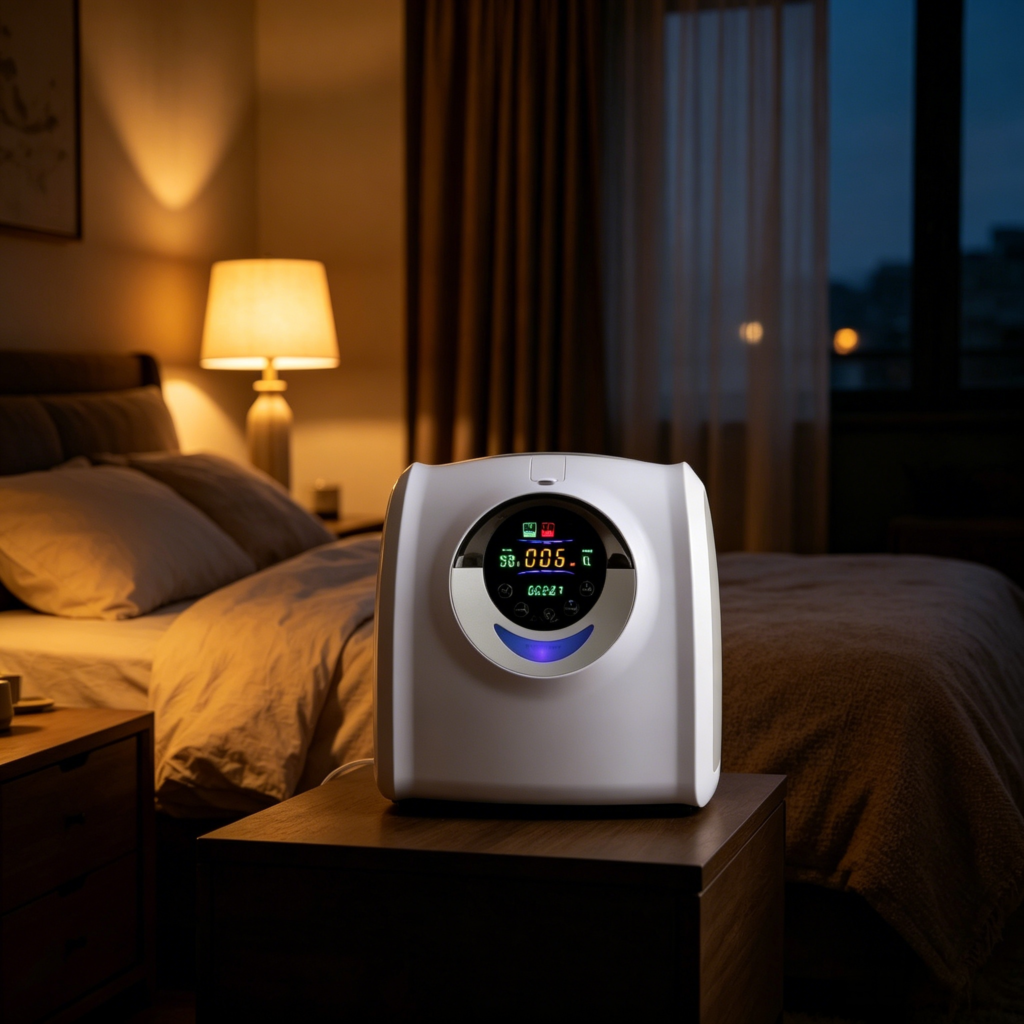
2026 standard models operate at approximately 48dB, equivalent to the sound of quiet conversation. Placed on a nightstand, they will not interfere with normal sleep.
Size and Weight: Comparison of Two Mainstream Models
For different usage scenarios, two mainstream sizes are currently available:
| Model | Dimensions (L×W×H) | Weight | Best For |
|---|---|---|---|
| Compact Model | 325×302×168mm | 5.2kg | Bedrooms, offices, travel |
| Standard Model | 410×376×220mm | 6.2kg | Living rooms, permanent installation |
The compact quiet oxygen machine for home use weighs only 5.2kg, easily portable even for women.
Usage Experience: Earphone-Style vs Nasal Cannula Options
Standard models provide both earphone-style and nasal cannula delivery methods.
Earphone-style is comfortable for extended wear, while nasal cannula offers higher oxygen utilization efficiency for scenarios requiring higher concentrations.
Key Selection Points for Adjustable Flow Quiet Home Oxygen Concentrators
Adjustable flow quiet home oxygen concentrators that can meet diverse scenario needs are the first choice for most families.
Flow Adjustment Range: 1-6L/min is Sufficient for Home Use
This range covers all needs from daily wellness to moderate breathing discomfort:
- 0.5-1L/min: Daily wellness, studying and working
- 1-2L/min: Mild breathing discomfort, nighttime use
- 2-3L/min: Moderate breathing discomfort, post-exercise recovery
Flow Stability: Fluctuation ≤±0.1L/min
Unstable flow causes fluctuating oxygen concentrations, reducing effectiveness.
High-quality adjustable flow quiet home oxygen concentrators use precision flow control valves, maintaining flow fluctuations within ±0.1L/min.
Filtration System: Multi-Layer Filtration for Healthier Air
The filtration system directly impacts the quality of oxygen delivered.
We recommend models with at least three filtration layers:
- Pre-filter: Captures dust, hair and other large particles
- HEPA filter: Removes PM2.5 and other fine particles
- Activated carbon filter: Eliminates odors and harmful gases
Real Case Study: How Choosing the Right Low Noise Home Oxygen Concentrator Transformed Daily Life
45-Year-Old Mr. Li’s Dual Office and Home Needs
Mr. Li is a product manager at an internet company who often works late into the night.
He experienced mild dizziness and difficulty concentrating, and his doctor recommended daily oxygen supplementation for improvement.
Wrong Purchase Experience: Noise Issues with High-Flow Model
In October 2025, Mr. Li purchased a 5L oxygen concentrator online for 3299 yuan.
However, actual use revealed significant noise problems:
- In the office, colleagues could clearly hear the humming sound
- In the bedroom at night, it made sleep impossible
- The machine was eventually stored unused on the balcony
Improved Experience After Correct Selection
In February 2026, following our recommendation, Mr. Li purchased a 1.5ata low noise oxygen equipment for breathing issues.
After three months of use, Mr. Li reported:
- Operating at approximately 48dB, usable in both office and bedroom
- 2 hours of daily office use significantly improved concentration
- 1 hour before bed greatly enhanced sleep quality
- The compact model fits easily on his desk without taking space
- He now uses it daily, making it an integral part of his routine
Low Noise Home Oxygen Concentrator Buying Guide: Pitfall Avoidance Checklist
3 Parameters You Must Verify Before Purchase
- Working pressure: Must be between 1.0-2.0ata
- Operating noise: Require third-party certified noise test reports
- Flow-concentration relationship: Confirm ≥90% concentration at 1L/min
Required Documentation
- Product quality test report (compliant with QB/T 5368-2019 standard)
- Third-party noise test report
- Clear after-sales service commitment
Critical After-Sales Protection Points
Daily use low noise home oxygen concentrators are long-term investment equipment, making after-sales support crucial.
We recommend brands offering:
- Minimum 2-year full machine warranty
- Nationwide after-sales service
- Regular on-site maintenance and servicing
Schedule a One-on-One Consultation with a Respiratory Therapist
Every individual’s physical condition and usage needs are unique—no single device works for everyone.
If you are unsure how to select the right low noise home oxygen concentrator for your needs, or have any questions about home oxygen equipment, we invite you to schedule a one-on-one consultation with our respiratory therapist.
We will provide professional, personalized purchasing recommendations based on your specific situation, helping you find the perfect device for your lifestyle.
Schedule Now: Complete the form below, and we will contact you within 24 hours.
Authoritative References:
- Global Initiative for Chronic Obstructive Lung Disease (GOLD). Global Strategy for the Diagnosis, Management, and Prevention of Chronic Obstructive Pulmonary Disease 2026
- World Health Organization. Nighttime Noise Guidelines (2025 Updated Edition)
- China Light Industry Standard QB/T 5368-2019: Household Oxygen Concentrators
- China Report Hall. 2026 Oxygen Concentrator Industry Prospect Analysis Report